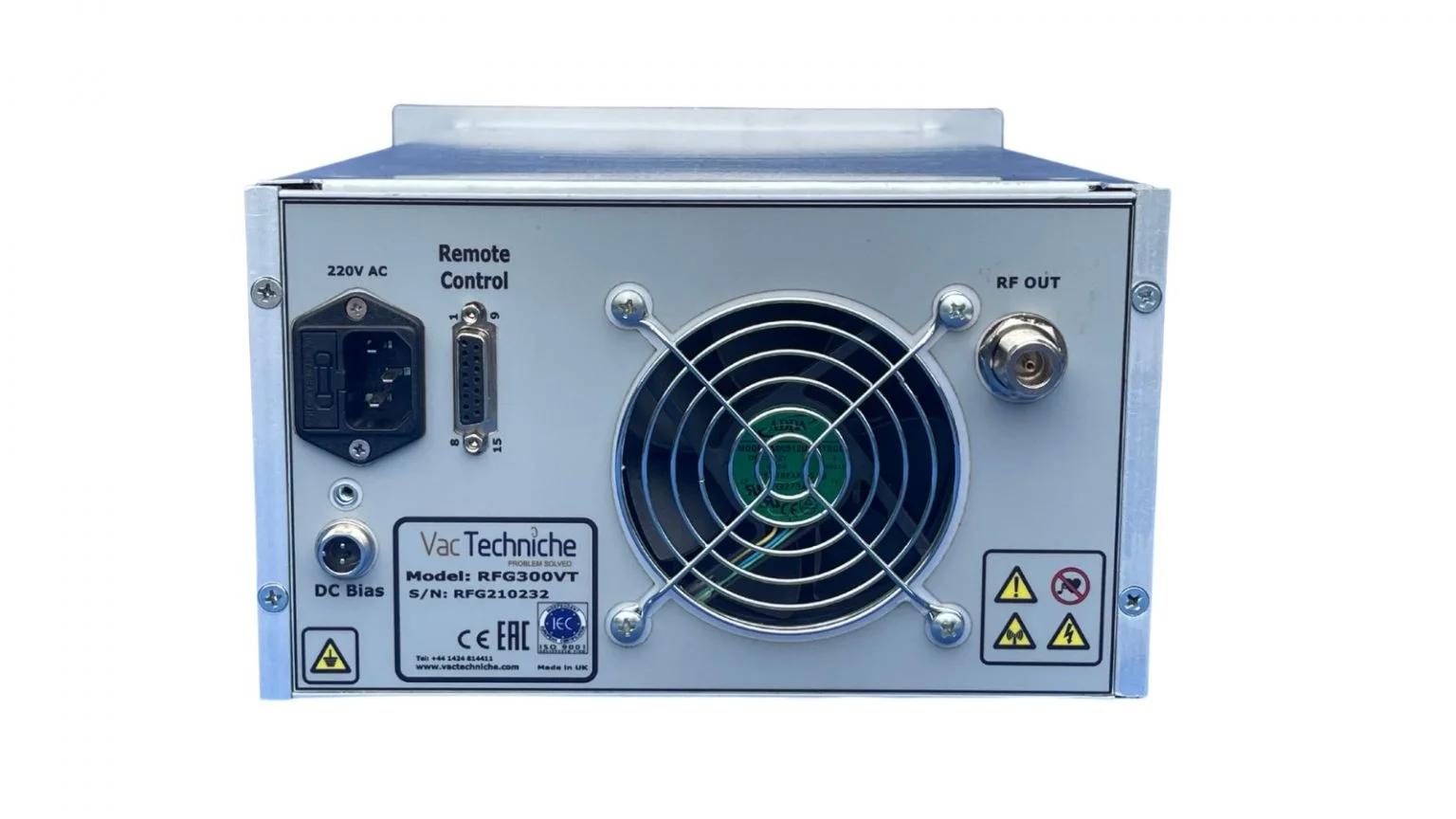

RF Power Generator for Plasma & Sputtering Systems
An RF power generator converts electrical energy into controlled radio-frequency output — typically at 13.56 MHz — to power plasma systems, magnetron sputtering, and thin-film deposition equipment. Whether you are specifying a system for a research lab or scaling up an industrial coating process, choosing the right RF power generator directly affects plasma stability, process repeatability, and equipment longevity.
VacTechniche supplies RF power generators ranging from 300W bench units to multi-kilowatt industrial configurations, paired with automatic matching networks designed for demanding plasma and sputtering environments.
Looking for a Custom Configuration?
Tell us your power level, frequency, and application. Our team will recommend the right RF generator and matching network for your system.
What Is an RF Power Generator?
An RF power generator is the core power source in any RF-driven plasma or sputtering system. It takes standard mains power and produces a stable high-frequency alternating signal that drives the process chamber. The output is delivered through a coaxial cable to a matching network, which then transfers the power efficiently into the plasma load.
Unlike DC power supplies, RF generators work with both conductive and insulating target materials, making them more versatile for advanced thin-film and surface treatment processes. They are also better suited to capacitively coupled plasma systems where DC would cause charge buildup on insulating surfaces.
Key Specifications to Consider
When selecting an RF power generator, these are the most important parameters to evaluate for your application:
- Output frequency: 13.56 MHz is the global ISM-band standard for plasma and sputtering. Some specialist applications use 2 MHz or 27 MHz.
- Power output range: Common ranges are 300W, 600W, 1200W, 3000W, and 5000W. Choose based on your chamber size and process requirements.
- Reflected power protection: A quality generator includes automatic protection circuits that reduce or shut off output when reflected power exceeds safe thresholds.
- Control interface: Analogue, RS-232, Ethernet, or front-panel control depending on your automation requirements.
- Matching network compatibility: Most RF generators require a dedicated RF matching network to operate efficiently.
- Duty cycle and cooling: Continuous vs. pulsed operation and whether air or water cooling is required.
RF Power Generator vs RF Power Supply — Is There a Difference?
The terms are often used interchangeably in industry. Strictly speaking, an RF generator refers to the complete unit that creates, amplifies, and conditions the RF signal, while an RF power supply emphasises the power delivery role. In practice, when engineers specify an RF power supply for plasma or sputtering, they are referring to the same class of equipment.
Featured Products
300W RF Generator for Magnetron Sputtering and Plasma Generation
Designed for dual magnetron sputtering systems and plasma generation, this compact 300W unit operates at 13.56 MHz and is built for laboratory and light industrial use. It delivers stable, repeatable output with front-panel power control and includes protection against reflected power and overload conditions. Best paired with an automatic matching network for optimum performance.
RF Matching Network for Sputter Systems
The RF matching network dynamically adjusts the impedance between the generator output and the plasma chamber, ensuring maximum power transfer and protecting the generator from reflected power. Available in auto and manual tune configurations, and compatible with a range of RF generator power levels. This is an essential component in any RF-driven sputtering or plasma system.
Request a Quote
Need a complete RF power generator and matching network solution? Get a tailored recommendation from the VacTechniche team.
Where RF Power Generators Are Used
RF power generators are used across a wide range of scientific and industrial environments. In research labs, they power desktop sputtering systems, plasma cleaners, and reactive ion etching equipment. In industrial settings, they drive larger-scale thin-film deposition lines, surface activation systems, and semiconductor fabrication processes.
Common applications include:
- Magnetron sputtering of metals, oxides, and nitrides
- Plasma-enhanced CVD (PECVD) for thin-film growth
- Plasma cleaning and surface activation before bonding or coating
- Reactive ion etching (RIE) for micro and nanofabrication
- Plasma ashing of photoresist in semiconductor processing
Conclusion
An RF power generator is one of the most important components in any plasma or sputtering system. Getting the power level, frequency, and matching configuration right makes a direct difference to process quality and system reliability. VacTechniche offers RF generators and matching networks suited to both research and industrial environments, and our team can help you specify the right solution for your application.
Browse our 300W RF generator, explore our RF matching network range, or request a quote to get started.
Frequently Asked Questions
What is an RF power generator used for?
RF power generators provide high-frequency energy to plasma and sputtering systems used in research, semiconductor processing, and industrial thin-film coating.
What power levels are available?
Common RF generator power levels range from 300W for laboratory systems up to 5000W and beyond for industrial applications.
Do I need a matching network with an RF power generator?
Yes. A matching network is required to match the generator output to the dynamic impedance of the plasma load. Without it, reflected power will reduce efficiency and can damage the generator.
What is the standard frequency for RF plasma generators?
13.56 MHz is the most widely used frequency because it falls within the ISM band, making it globally license-free and well suited for industrial plasma systems.
What is the difference between an RF generator and a DC power supply for sputtering?
RF generators are suited for dielectric materials and capacitive plasma processes. DC power supplies are better for conductive targets. Many systems use both depending on the process requirements.
RF power generator for plasma
RF power generators for sputtering


