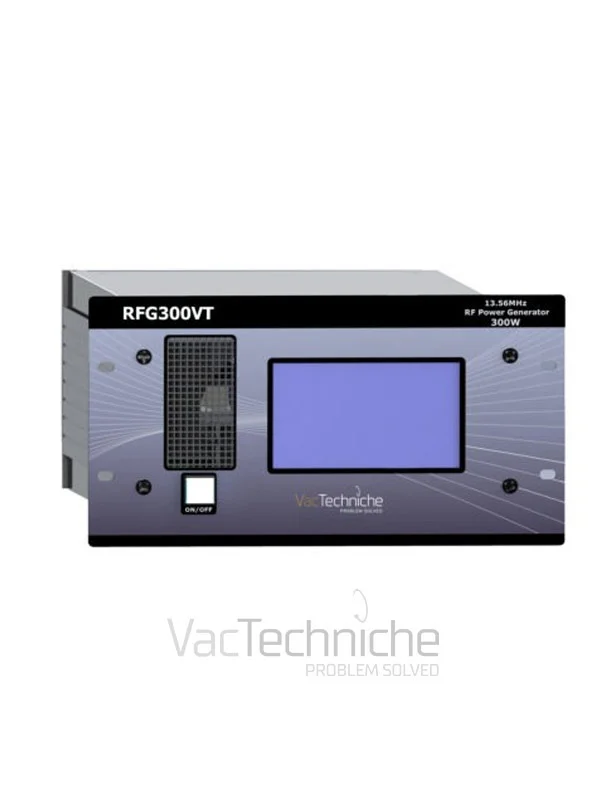

RF Power Supply for Plasma and Magnetron Sputtering
An RF power supply for plasma provides the controlled high-frequency power needed to generate and sustain plasma in sputtering, deposition, etching, and surface treatment systems. In magnetron sputtering, the power supply plays a central role because it determines how efficiently the chamber receives energy and how stable the plasma remains during operation.
For many plasma applications, 13.56 MHz is the standard operating frequency. However, the correct power supply also depends on power range, chamber design, target material, and whether the system needs a matching network for efficient energy transfer.
Need the Right RF Power Supply for Your Plasma System?
Tell us your chamber size, target material, power requirement, and operating frequency. VacTechniche can recommend the right RF power supply and matching network for your sputtering or plasma process.
What an RF Power Supply Does
An RF power supply converts electrical input into controlled radio-frequency output that can ignite and sustain plasma. In plasma and sputtering systems, this output reaches the chamber through a matching network, so the load can stay tuned for efficient power transfer. As a result, the system delivers more stable plasma and lower reflected power.
Because plasma impedance changes during operation, the RF power supply must work together with the matching network as one complete RF power chain. Without proper matching, the system becomes less stable and the generator cannot deliver power efficiently.
Why RF Power Is Used in Magnetron Sputtering
RF power is especially useful in magnetron sputtering when the target material is insulating or when the process requires more stable plasma behavior. Unlike DC power, RF power can sustain plasma on dielectric targets and reduce issues caused by charge buildup. Therefore, RF sputtering is commonly used for oxides, nitrides, and other non-conductive materials.
In addition, RF power supplies are widely used in research coating systems, semiconductor processing, and thin-film deposition where control and repeatability matter more than simple system design.
Common Power Ranges
The correct RF power supply depends on the size of the chamber, the process type, and the required throughput. Smaller systems often use compact bench-scale units, while production systems may require much higher power.
- 100W–300W: Small laboratory plasma systems, research sputtering, and compact coating tools.
- 600W–1200W: Mid-range sputtering and plasma processing systems with larger chambers or higher output requirements.
- 3000W–5000W: Industrial plasma systems, production coating lines, and larger vacuum environments.
- Custom power levels: Available for specialized semiconductor, thin-film, and industrial applications.
Matching Network Compatibility
An RF power supply usually requires a matching network to transfer energy efficiently into the plasma load. Because the chamber impedance changes during ignition and operation, the matching network adjusts the load seen by the generator and helps reduce reflected power. As a result, the system runs more smoothly and protects the RF power supply from unnecessary stress.
This is why the RF power supply and the matching network should always be considered together. Choosing one without the other can lead to unstable plasma, reduced efficiency, and unnecessary wear on the equipment.
Featured Product Links
This page should guide users toward the most relevant VacTechniche solutions for RF plasma and sputtering applications. These are the strongest supporting internal links for this topic.
300W RF generator, RF plasma generator, RF matching network, and RF power supplies are the key pages to highlight here.
How to Choose the Right RF Power Supply
When selecting an RF power supply for plasma, start with operating frequency, output power, target material, chamber size, and process stability requirements. If you work with insulating materials or changing plasma loads, RF is often the correct choice. If the process is simple and uses conductive targets, DC may still be suitable for other applications.
You should also confirm whether the system needs automatic tuning, analog or digital control interfaces, rack integration, and additional protection features. These details affect reliability, ease of use, and long-term system performance. Furthermore, they help you avoid unnecessary downtime after installation.
Request a Quote
Need a plasma or magnetron sputtering power supply matched to your process? Contact VacTechniche for a tailored recommendation based on your system requirements.
Conclusion
An RF power supply for plasma is a critical component in sputtering, deposition, and plasma processing systems. It works best when you select it together with the correct matching network, power level, and chamber configuration. Therefore, the full RF chain should always be designed as one system rather than separate parts.
For VacTechniche systems, the most relevant next steps are to review the 300W RF generator, the RF plasma generator, the RF matching network, and the broader RF power supplies page.
Frequently Asked Questions
What is an RF power supply for plasma?
An RF power supply for plasma generates high-frequency electrical power used to create and sustain plasma in sputtering, deposition, etching, and cleaning systems.
Why is RF power used in magnetron sputtering?
RF power is used because it can sustain plasma on insulating targets and provides stable operation for many thin-film deposition processes.
Does an RF power supply need a matching network?
Yes. In most RF plasma systems, a matching network is required to reduce reflected power and improve energy transfer into the chamber.
What frequency is common for RF plasma power supplies?
13.56 MHz is the most common industrial frequency for RF plasma and sputtering systems.


